Let Us Help You Make Your Musical Dreams Come True
Music Essentials 1 Section6 LessonsLifetime
Lesson 1 – The Grand Staff
You will now be introduced to the keyboard. Music theory is best helped by using the grand staff. All the notes are right in front of you so you can see how various concepts follow through. The music world is based on notes; and only 7 of them. Notes A, B, C, D, E, F, and G. Actually, I suppose you could see that there are more than 7 notes only because each note has a sharp and a flat associated with it. The concept of sharps and flats will be discussed later.
Take a look at the following and see the notes on the grand staff:
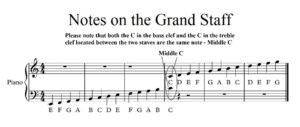
The Grand Staff is a combination of the Treble and Bass clefs. Not all instruments use the Grand Staff and not all instruments use the treble and bass clefs. Most instruments use either the treble or the bass. So, for the purposes of Music Theory, we shall use both. Note that some instruments use the Alto clef 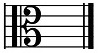 while others use the Tenor clef
  . We will explain these two clefs later.
The treble clef 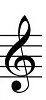 and the bass clef
  are each on a staff which is made up of five lines. These lines are called ledger lines. Each clef has 5 ledger lines and 4 spaces. The placement of notes will be on a line or a space. As seen in the above image, the first note on the bass clef “E” is a line note as it has a line running through it. The next note “D” is a space note, the next note “G” is a line note and so on. Since the “E” is below the five lines of the clef, there is a need to run a ledger line through it as it would be the next line note below the staff. When this occurs with a note above or below the staff a small ledger line is used and it is limited to just that note. The new ledger line is not extended the full length of the staff.
The treble clef is also called the G clef. Notice that the circular part of the symbol circles around the ledger line that the G is on. The bass clef is also called the F clef. Notice that the two dots are above and below the ledger line that the F is on.
Now on to Notes!